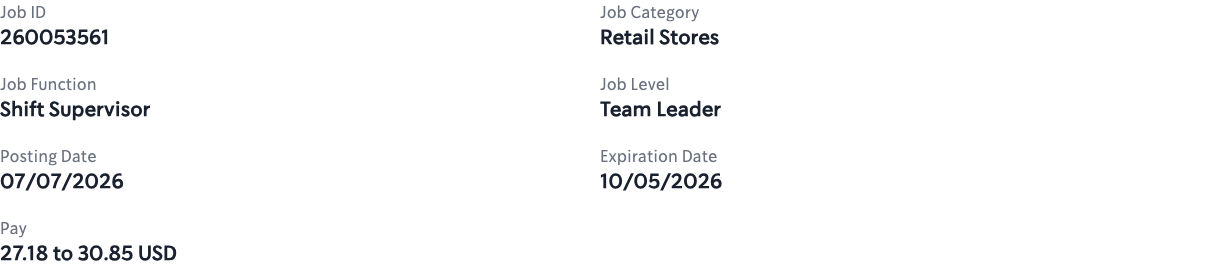
Treat a benefit as usable only after the role matches the eligible population, waiting period, hours rule, employer, location, and controlling plan. Put the start date beside the program name.
A different role in the same city, with its own job ID, expiration date and range. An offer comparison runs on those fields, not on the city.
5selected evidence cases
25employers in the fixed report
37fixed posting observations
Research question
Does the applicant qualify for this program, and when would the value begin?
Walmart's Live Better U language can support day-one access for named eligible groups while excluding others. Amazon's Career Choice evidence uses a 90-day clock for eligible hourly populations. Starbucks separates programs across different eligibility conditions. Chipotle's immediate restaurant value should not be bundled with benefits that require tenure, hours, or performance. Hilton education support for owned or managed properties cannot automatically be transferred to a franchised hotel. These differences are decision evidence, not generic good-benefits copy.
Applicant rule
Write each benefit as program + eligible population + waiting period + hours or status requirement + location or employer boundary + source date. Enter zero value in a comparison until the current posting, offer, or plan confirms the applicant qualifies.
Use this brief in three moves
Build an eligibility timeline for this role
01
Name the eligible group
Connect the program to the employment class, employer, location, and role named by the source.
02
Calculate the first possible date
Record the waiting period, service clock, hours threshold, or enrollment window.
03
Check the controlling terms
Use the current plan or offer language when a summary and the applicant's actual role differ.
Selected evidence cases
Five eligibility rules hidden behind familiar benefit names
The cases separate named populations, waiting periods, immediate value, program-specific conditions, and property ownership. The source-access date belongs to the benefit fact itself so an applicant can recheck rules that may change.
01
Walmart
named day-one Live Better U groups
Walmart's Live Better U page says eligible programs cover 100% of tuition and required books, with little or no out-of-pocket cost. It says full-time and part-time hourly and salaried Walmart and Sam's Club associates are eligible on day one; temporary associates and salaried associates at market level and above are not eligible; associates who already hold a bachelor's degree are not eligible for Live Better U programs; and there is no obligation to stay at Walmart or Sam's Club after completing a degree or certificate.
Evidence date:
Known limit: Two current requisitions were retained; another role family would broaden the sample.
About Amazon says Career Choice is open in the U.S. to the vast majority of hourly full-time and part-time employees after 90 days while they remain eligible, with prepaid tuition and book/fee reimbursement up to the annual amount. Amazon's hourly benefits page also frames Career Choice as available after 90 days for regular full-time, reduced-time, and part-time employees, so eligibility should be described with the 90-day and schedule/employee-type caveats.
Evidence date:
Known limit: Two current data-center postings were retained, while the hourly search returned an automated-access error.
Starbucks College Achievement Plan (SCAP) is officially described as 100% upfront tuition coverage for U.S. partners who are benefits-eligible to earn a first-time bachelor's degree through Arizona State University's online program. The SCAP page says participating partners must be benefits eligible, work in the U.S., and complete FAFSA; the benefits site notes that legal plan documents govern if there is a discrepancy. Applicants should not assume SCAP applies to non-U.S. roles, non-benefits-eligible partners, previous-degree situations, or programs outside the ASU Online first-time bachelor's pathway.
Evidence date:
Known limit: Licensed Starbucks counters can use a different employer and application system from company-operated stores.
Chipotle's current benefits page says hourly crew can receive up to $5,250 each year toward education goals plus the Debt-Free Degree program. The public page calls its list a preview and directs employees to Cultivate Me for the most current and detailed terms; it does not state one complete public waiting-period, average-hours, school, or program-eligibility rule for every crew member. Applicants should therefore distinguish the advertised maximum from their approved award and verify tenure, covered programs, Guild availability, and whether the posting is hourly crew or restaurant management before relying on a tuition path.
Evidence date:
Known limit: One current crew record was retained, and its refresh date was not treated as the original posting date.
Hilton's Guild education benefit is not automatically franchised-property-wide. Hilton's official Guild release says Team Members at U.S. owned and managed properties plus corporate locations can earn debt-free credentials including high school completion, English-language learning, digital literacy, professional certifications in culinary, business, data analytics and technology, and college degrees. Hilton's SEC filing says franchised-property workers are employed by third-party owners, not Hilton. This legal-employer caveat is central: applicants at franchised Hilton-branded properties should verify whether their employer participates before relying on Hilton corporate education benefits.
Evidence date:
Known limit: No current individual posting with a retained identifier, numeric pay, and schedule was available in the snapshot.
Turn each benefit promise into an eligibility timeline
Record when value starts and which employer, location, hours, status, or plan terms qualify the applicant. A benefit belongs in an offer comparison only after those conditions match the actual role.
The selected facts show different eligibility structures. Apply the same fields to the applicant's current role and let the controlling plan document settle conflicts.
The 25-employer/37-posting transparency report and the separate 16-company/58-record published-cohort
appendix remain distinct fixed outputs.
Public benefit pages summarize programs and eligibility rules. The controlling plan document and the applicant's actual employer, location, hours, and status determine eligibility.