Start with the employer or operator named on the current posting. Keep that name beside the location, application account, payroll terms, and written offer before you compare the job with another familiar brand.
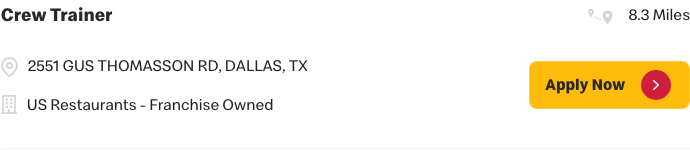
Observed · McDonald's record PDX_MC_4ADF634F-09B5-4887-930E-10B4BD7F7CA0_17108
McHire labels this Dallas restaurant franchise owned before the applicant reaches the handoff.
5selected evidence cases
25employers in the fixed report
37fixed posting observations
Research question
Who would actually hire, pay, schedule, and provide benefits for this role?
McDonald's, Chick-fil-A, and Taco Bell can place local Operators or franchise employers between the brand and the applicant. A Hilton-managed hotel can still have a third-party owner as employer, while Marriott postings can expose operator context separately from the hotel flag. Albertsons adds a parent–banner–formal employer chain; Starbucks licensed counters can use the host retailer's system; FedEx roles can belong to distinct operating companies. The practical error is to compare two logos while ignoring two legal employers.
Applicant rule
Record the legal employer or operator beside the brand, property or store, requisition, payroll terms, and benefit plan. If the posting does not identify it, mark the field unresolved until the written offer does.
Use this brief in three moves
Find the employer before you compare the offer
01
Read the employer field
Copy the company, franchisee, operator, owner, or operating-company name shown on the job record.
02
Match the application
Keep the restaurant, property, store, or business unit beside the account and confirmation that receive the application.
03
Confirm the written terms
Use the same legal employer when checking pay, schedule, benefits, and the final offer.
Selected evidence cases
Five ways a familiar brand can point to a different employer
These cases isolate different identity boundaries: restaurant Operator, hotel owner, grocery banner, licensed counter, and operating company. The official link and evidence date show where the boundary was observed; the current posting and written offer still control.
01
McDonald's
restaurant operator versus corporate lane
Restaurant cards identified location and franchise-owned status before the application handoff.
Evidence date:
Application system: Restaurant and hourly roles use McHire / Olivia; corporate roles use careers.mcdonalds.com / Sam; early-career candidates use the university process
Known limit: One restaurant card and one corporate requisition were retained; the restaurant detail endpoint was region-limited.
The search surface separated Marriott, franchise, and third-party operator context from the hotel brand.
Evidence date:
Application system: Marriott Careers uses Olivia for job discovery and application guidance; the final Apply path can continue through Marriott-hosted candidate pages or an external property/operator route depending on the posting
Known limit: The retained corporate requisition had expired, so a fresh current posting sample is needed.
The public application path returned candidates to a profile while employer identity still varied by property.
Evidence date:
Application system: Hilton Jobs with Oracle Candidate Experience profile/search routes; the exact posting can be for Hilton corporate, a Hilton-managed property whose owner is the employer, or a franchised property with a separate employer process
Known limit: No current individual posting with a retained identifier, numeric pay, and schedule was available in the snapshot.
Build an employer-identity record before comparing offers
Treat the brand as a starting label, then preserve the entities that appear in the application and offer. An unresolved employer field is a question to carry forward, not a reason to fill the gap from the logo.
01
Name on the posting or requisition
02
Legal employer named in the application or offer
03
Franchise, Operator, owner, banner, or operating-company language
Use the current posting and offer as the final employer record
These selected records show where an employer boundary becomes visible. Repeat the same check for the applicant's current location instead of carrying one restaurant, hotel, counter, or operating-company result to another.
The 25-employer/37-posting transparency report and the separate 16-company/58-record published-cohort
appendix remain distinct fixed outputs.
This brief identifies public employer-boundary signals. It does not determine the legal employer for an applicant whose current posting or written offer names a different entity.