
HireTea Independent hiring research

The independent hiring research desk

Get the tea on hiring, backed by the source.

Company hiring guides built from current employer pages, active postings, and visible caveats. Start with the pattern, then verify the exact role before you apply.

Research ledger

25 featured company dossiers
288 facts linked to public sources
2026-07-12 latest source review in this set

Editorial starting points

Twelve examples from the full source-audited directory

The homepage intentionally highlights 12 companies across retail, restaurant, grocery, logistics, hospitality, pharmacy, and tech research. It does not repeat the full 25-company directory. Each selection opens a company page with a direct portal or posting review, an editorial caveat, source-backed facts, and the evidence HireTea excluded or marked for follow-up.

Open the complete 25-company directory.

Cross-company research briefs

Five conclusions from the current hiring evidence set

These are HireTea's editorial syntheses across 25 published company dossiers—not generic job-search instructions. Each conclusion links back to company research where the source trail, access date, competing evidence, and known limit can be inspected.

Company dossiers
25
Source-backed facts
288
Linked source records
415
Field findings
94

Employer identity

The logo is often not the employer

Across restaurant, hotel, grocery, retail-counter, and logistics research, the brand customers see can be different from the organization that hires, pays, schedules, or provides benefits. That is not a footnote: it changes which portal, policy, and offer terms an applicant should trust.

McDonald's, Chick-fil-A, and Taco Bell can place local Operators or franchise employers between the brand and the applicant. A Hilton-managed hotel can still have a third-party owner as employer, while Marriott postings can expose operator context separately from the hotel flag. Albertsons adds a parent–banner–formal employer chain; Starbucks licensed counters can use the host retailer's system; FedEx roles can belong to distinct operating companies. The practical error is to compare two logos while ignoring two legal employers.

Applicant rule

Record the legal employer or operator beside the brand, property or store, requisition, payroll terms, and benefit plan. If the posting does not identify it, mark the field unresolved until the written offer does.

Portal architecture

One company name can hide several application systems

The route used to apply is evidence. It determines the candidate account, status return path, stored messages, and sometimes the job population itself. A careers homepage is a discovery layer; the final vendor, account, or local contact is the transactional record.

Amazon separates hourly warehouse hiring from amazon.jobs. McDonald's uses Olivia for restaurant discovery and Sam plus corporate systems for other roles. FedEx sampled postings use different backends by company, role, and region. Costco pharmacy and warehouse flows can sit on separate hosts, while Disney applicants may need different dashboards for different businesses. These technical splits do not automatically prove separate recruiters or screenings, but they do prove that a universal 'check your status here' instruction can be wrong.

Applicant rule

Save the final Apply URL, account email, job ID, confirmation, and the exact page used to return. Do not infer a submitted application from a saved job, search result, chatbot conversation, or profile that belongs to another lane.

Pay visibility

A disclosed number is only as useful as its requisition

Pay transparency in this set is not a simple company ranking. Some employers reveal local pay on result cards, some publish a range only inside a detail page or apply flow, and others provide broad workforce averages alongside role-specific terms. The unit of comparison must remain the job, location, level, and pay basis.

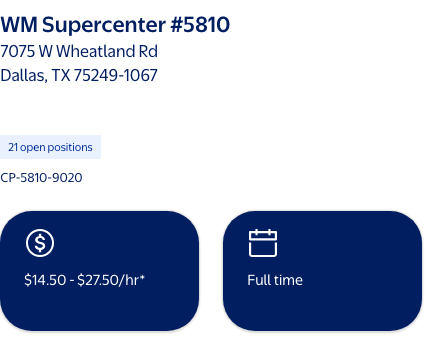
Walmart can surface pay, shift, and location before the detail click, while Apple binds pay to a Role Number and sometimes states where new hires tend to start inside the range. TJX samples show the same title at different local rates. Costco and many sampled Lowe's pages leave the applicant with an unresolved pay question at discovery. Taco Bell's local operator and location change how a posted number should be read. A national average, maximum range, differential, bonus, or total-compensation figure answers a different question from starting base pay.

Applicant rule

Capture base range, hourly or annual basis, location, shift differential, bonus or equity treatment, employment type, and date viewed. Do not turn one local sample into a brand-wide wage or count a range maximum as the likely offer.

Benefit eligibility

Benefits are clocks and boundaries, not a checklist

A benefits page can be accurate and still be misleading in an offer comparison when eligibility is removed. The useful questions are who is covered, when eligibility starts, which hours or employment class count, whether the location or Operator participates, and which plan terms control.

Walmart's Live Better U language can support day-one access for named eligible groups while excluding others. Amazon's Career Choice evidence uses a 90-day clock for eligible hourly populations. Starbucks separates programs across different eligibility conditions. Chipotle's immediate restaurant value should not be bundled with benefits that require tenure, hours, or performance. Hilton education support for owned or managed properties cannot automatically be transferred to a franchised hotel. These differences are original decision evidence, not generic 'good benefits' copy.

Applicant rule

Write each benefit as program + eligible population + waiting period + hours or status requirement + location or employer boundary + source date. Enter zero value in a comparison until the current posting, offer, or plan confirms the applicant qualifies.

Application status

A portal status is an observation, not an outcome prediction

Status labels are useful when recorded with a date and source, but they rarely explain the employer's internal decision. A live posting, unchanged profile, chatbot message, or empty dashboard should not be converted into an interview promise or rejection without direct evidence.

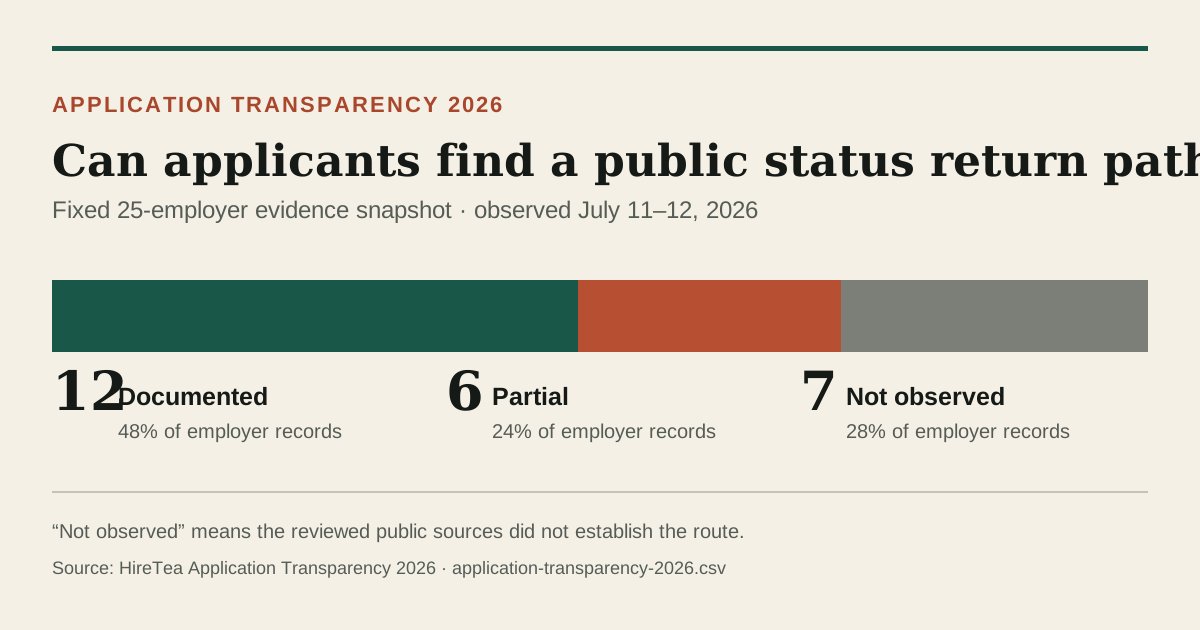
Walmart documents a dashboard and a 60-day hourly application period. McDonald's directs restaurant candidates to the local restaurant for status. Target relies on Candidate Home and role-specific Workday detail pages. Apple exposes a profile but does not publish a universal status vocabulary or response deadline. UPS separates hourly and professional return paths. These patterns show why a single status glossary cannot safely describe every employer: the same-looking label can belong to a different system and stage.

Applicant rule

Store the exact label, date viewed, account or contact route, confirmation, last employer message, and one next action. If the employer does not define the label, describe only what the screen shows and avoid guessing what happens next.

Reproducibility

Inspect the method and dataset behind the synthesis

Counts use the currently published dossiers. Employer identity, portal boundaries, pay visibility, benefit eligibility, and status handling are editorial codes grounded in the linked company evidence; they are not employer rankings or hiring-outcome predictions.